CyberPlay editorial team · Published · Updated · 8 min read
Guide and exercises in English
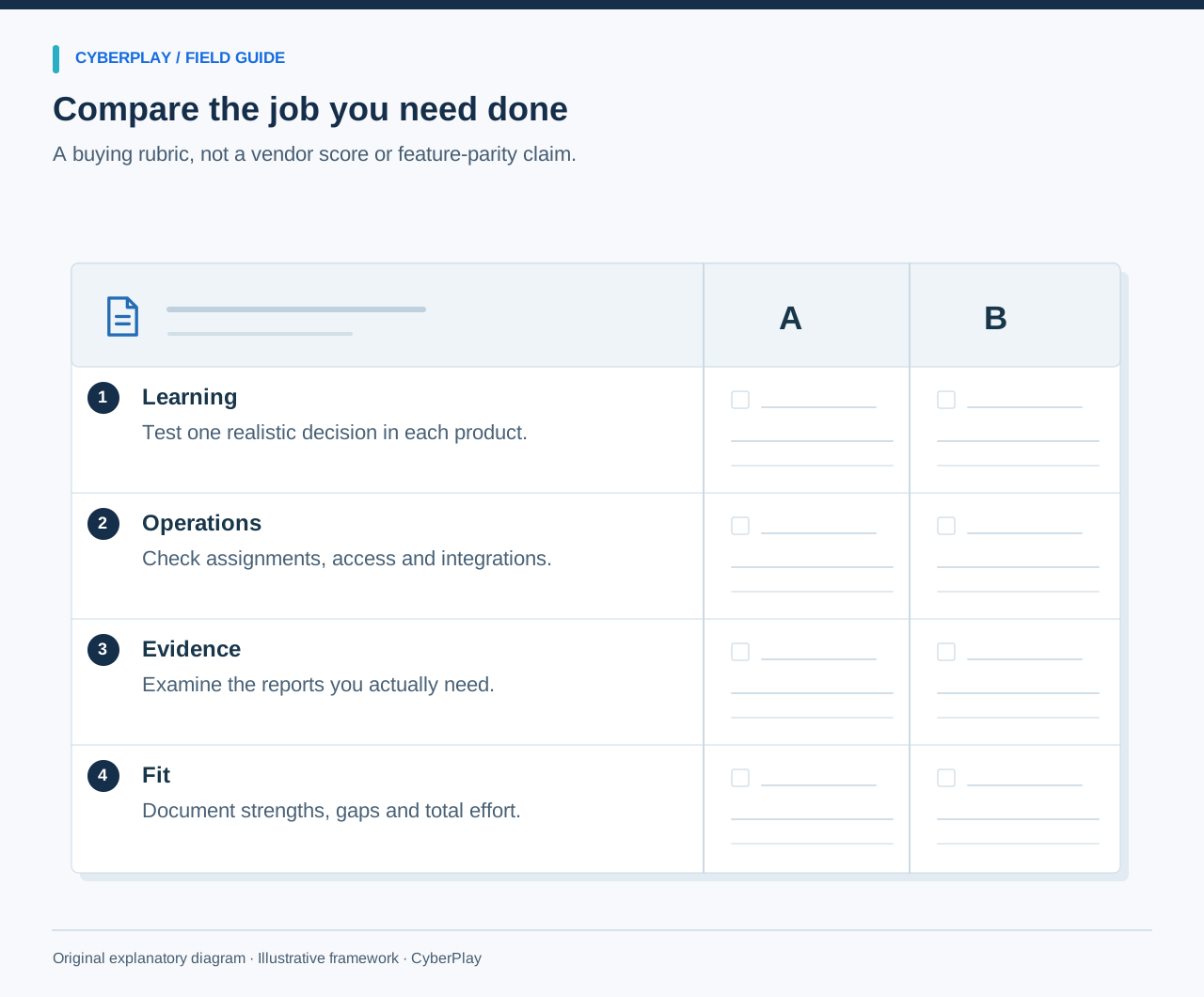
If you are looking for a KnowBe4 alternative, first decide which job you need to replace. You might want a different learning experience, less administration, specific language coverage, a different commercial arrangement, or a platform that meets particular technical requirements. Those are separate buying decisions.
CyberPlay is a candidate for teams seeking security practice through browser games. It can also be considered alongside an existing awareness programme. This comparison was prepared on 13 September 2026 using KnowBe4’s public product pages and CyberPlay’s current product implementation. It is a buyer’s framework, with unverified requirements clearly identified; it is not a claim of feature parity or an independent head-to-head effectiveness study.
What you’ll take away
- KnowBe4 already offers games as well as other training formats.
- A learning-content change does not automatically replace simulation and administration workflows.
- Verify must-have requirements before scoring preferences.
- Compare total programme cost and observed pilot results, not unsupported superiority claims.
Write down why you are considering a change
Begin with a concrete problem. “Employees rush through assigned modules” suggests a learning-design investigation. “We cannot produce the required report” is an evidence or administration issue. “The contract no longer fits our headcount” is a commercial problem. A new game may address the first and leave the others unchanged.
Ask the programme owner, IT administrator and a few employees to contribute separately. Convert their answers into acceptance criteria before attending demonstrations. For example: a learner must practise a supplier-verification decision; an administrator must identify incomplete assignments; the selected language must cover instructions and feedback. This makes a vendor conversation more useful than a long feature tour.
Recognise the capabilities KnowBe4 publishes
KnowBe4’s current library includes videos, interactive modules and games, and its library page describes LMS export options including SCORM. Its security awareness platform page describes attack simulations, automated training and reporting. It would be inaccurate to frame the choice as KnowBe4 offering only passive videos.
Published capabilities are a starting point for verification. Ask which are included in the proposed package, how they work with your environment, and which content meets your learning objective. A sample of a specific lesson is more informative than the size of the catalogue. Likewise, a report generated from your pilot is more informative than a demonstration with preloaded data.
Section sources: Security Awareness Training Library · Security Awareness Training
Use a dated capability comparison
The table distinguishes a documented product feature from a requirement that still needs demonstration. “Unverified” means this comparison has not established the capability; it is not a statement that the feature can never exist. Confirm the current offer and implementation before procurement, especially for integrations and contractual requirements.
| Requirement | KnowBe4 public offer | CyberPlay comparison position |
|---|---|---|
| Learning format | Library includes games, videos and interactive content | Browser-game catalogue focused on security practice |
| Delivered attack simulations | Described on the security awareness platform page | Equivalent email-campaign capability unverified; in-game practice is a different function |
| Organisation administration | Training automation and reporting described | Organisation members, assignments and game-result records exist; confirm plan and workflow |
| LMS content export | SCORM options described by the library | Equivalent SCORM package export unverified |
| Identity integration | Confirm the required provider and package in a demo | SSO configuration exists; verify the required provider end to end |
| Languages and accessibility | Check the exact selected modules | Check each selected game and an equivalent accessible activity |
| Price and contract | Obtain an offer for the required package | Check current plan, seats, term and included administration |
Section sources: Security Awareness Training Library · Security Awareness Training
Ask both products to teach the same decision
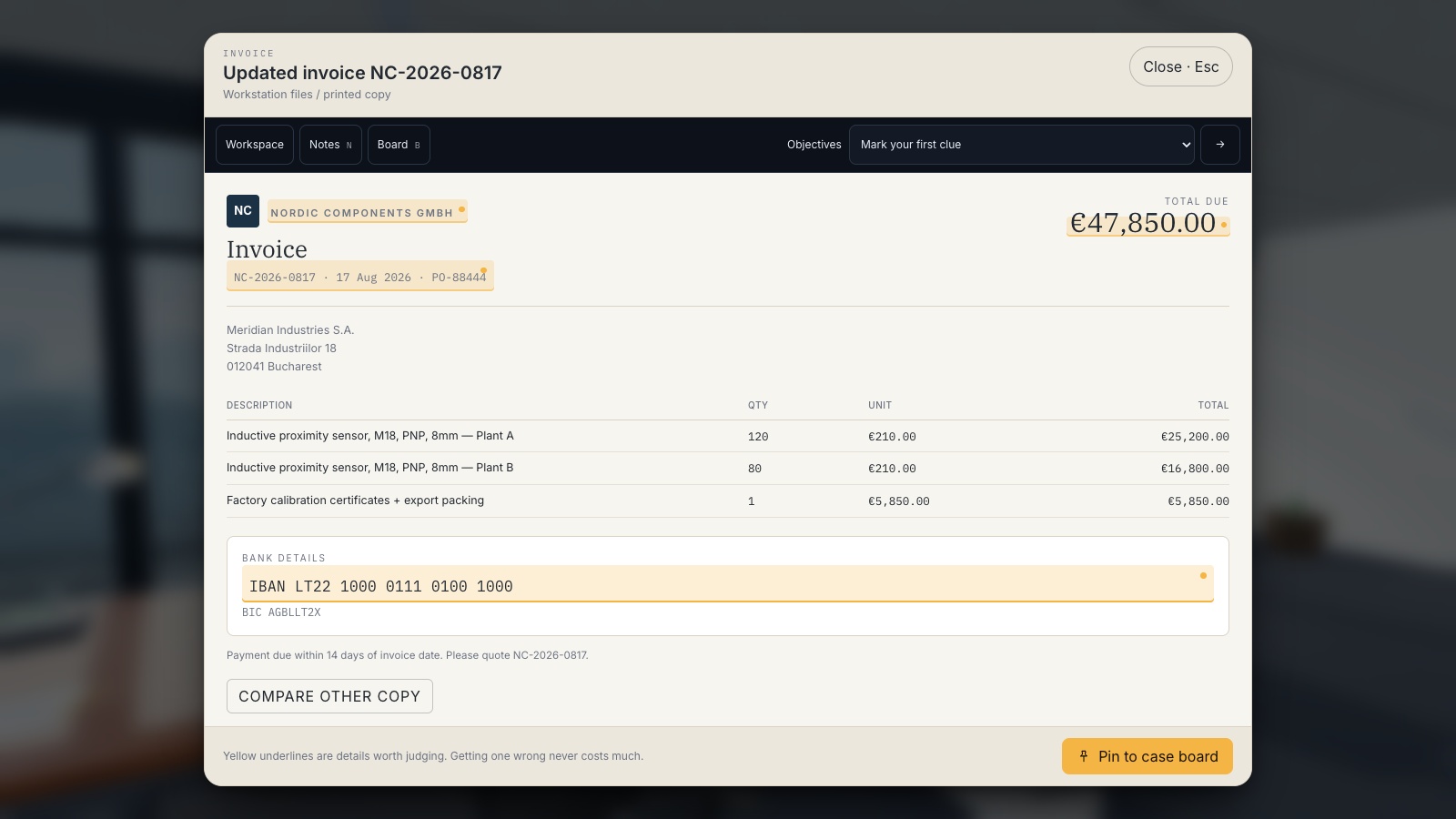
Choose one objective before the demo: “When payment instructions change, verify independently before acting.” Ask the presenter to show the learner making a mistaken choice and receiving feedback. Then ask how the activity handles an uncertain request and a legitimate control example. The exercise should demonstrate more than recognition of a suspicious logo.
For CyberPlay, select an appropriate topic and play the relevant game yourself. Judge whether the security decision affects the outcome and whether the explanation transfers to your workplace. For a KnowBe4 module, apply the same questions. Your decision should follow the actual experience and audience needs, not assumptions attached to a format label.
Expand image · Game screenshot · English interface
- Compare the changed details
Check which payment details changed and whether the request matches the expected invoice and work.
- Compare with trusted records
Compare with a trusted invoice, then verify changed bank details through the supplier contact already on record.
Test the administrator’s ordinary week
Write a short task list using fictional pilot members: add a learner, assign the relevant activity, find someone who has not completed it, inspect a result, export the records you need, and remove access. Include a changed department or duplicate import if those are common problems in your organisation.
Record the steps that require manual work and the permissions needed to perform them. CyberPlay’s organisation functionality includes member management, assignments and game results, with features controlled by plan and permissions. That does not establish compatibility with every HR system or learning platform. Ask for the specific integration or export you need rather than treating the word “dashboard” as a complete answer.
Keep simulation dependencies visible
If your existing programme sends test emails, uses a mailbox reporting button, or routes reported messages to a security team, map those dependencies before replacing it. List the system that sends messages, the component that handles reports, the people who investigate, and the records that must remain available.
Game-based phishing practice can help people learn what to inspect and how to respond. It should not be assumed to replace delivery infrastructure or message triage. If those functions are mandatory and remain unverified in a candidate, keep them as a gate. You can still pilot the candidate’s learning content as a complement while preserving the established operational workflow.
Expand image · Game screenshot · English interface
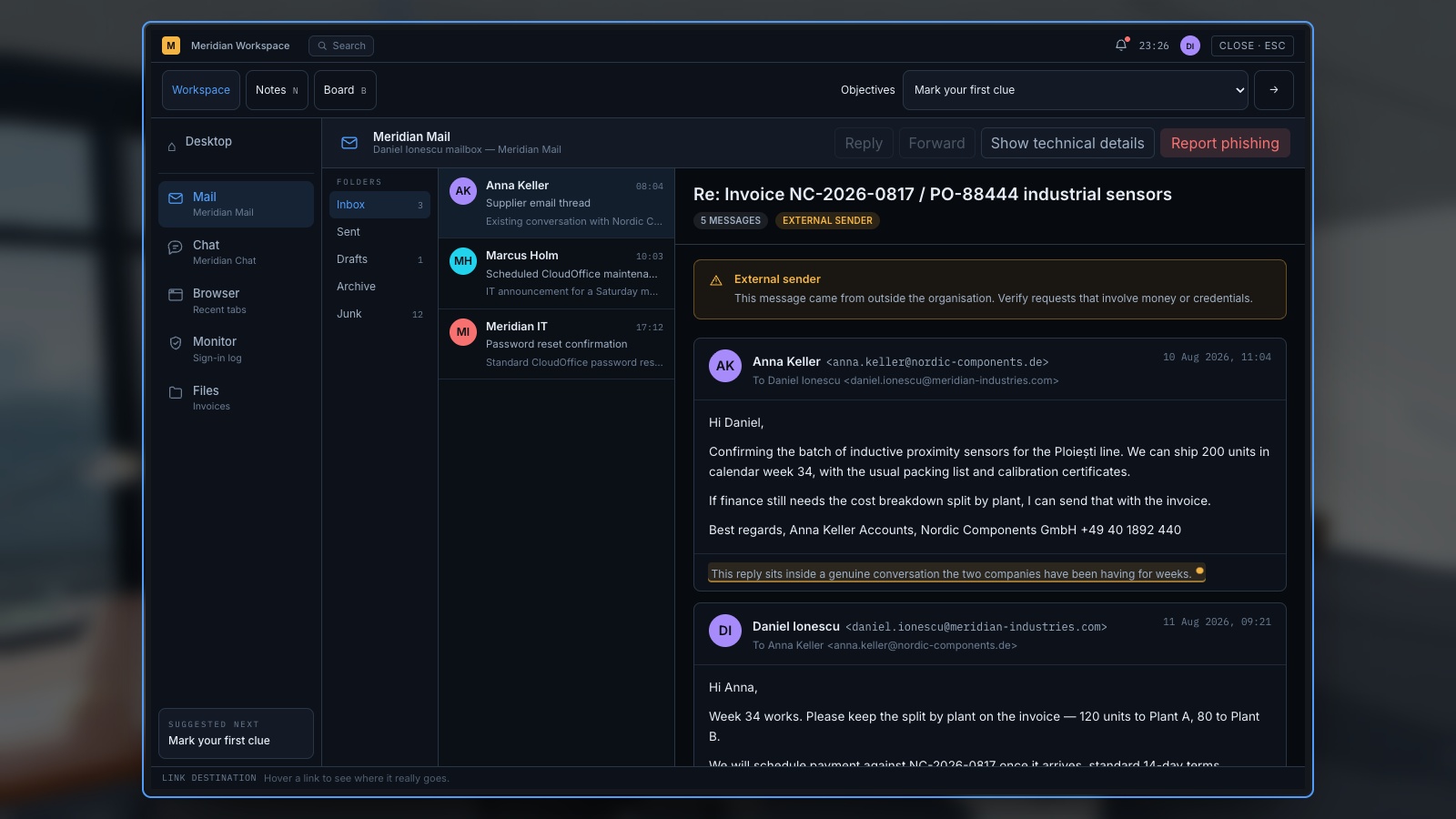
- Read the requested action
Identify what the message asks you to do before judging its familiar name or appearance.
- Verify through known contacts
Use an established contact route to verify an unexpected request, even when the sender seems familiar.
Compare the full cost of the programme
Use the same assumptions for both offers: eligible learners, billing term, support, required integrations, implementation work and data export. Include the time spent choosing content, managing exceptions and facilitating discussions. A lower subscription price may be outweighed by additional manual work; a broader package may include functions you do not need.
This article does not publish a claimed savings percentage or a universal per-user price. A useful comparison requires an actual current offer for your organisation. Record renewal terms, minimum commitments, treatment of inactive seats, and what happens to records when the contract ends. Keep commercial assumptions beside the capability assessment so a price is not detached from its scope.
Run a pilot with a decision scorecard
NIST SP 800-50r1 describes evaluating and improving a learning programme. Apply that discipline to procurement: agree success criteria before the pilot and collect evidence tied to each criterion. Separate mandatory requirements from preferences; a critical integration failure should not be averaged away by attractive visuals.
| Criterion | Evidence from pilot | Treatment |
|---|---|---|
| Learner can explain the next safe action | Unfamiliar scenario and written reason | Learning criterion |
| Audience can operate the activity | Observed device, language and access checks | Mandatory where needed |
| Administrator can produce required records | Actual pilot export with understood fields | Mandatory requirement |
| Required operational workflows continue | Demonstrated simulation/reporting/integration flow | Mandatory where in scope |
| Facilitation and administration effort are acceptable | Time recorded by the programme team | Cost criterion |
| Learners want to revisit useful practice | Feedback plus voluntary repeat use | Preference, not effectiveness proof |
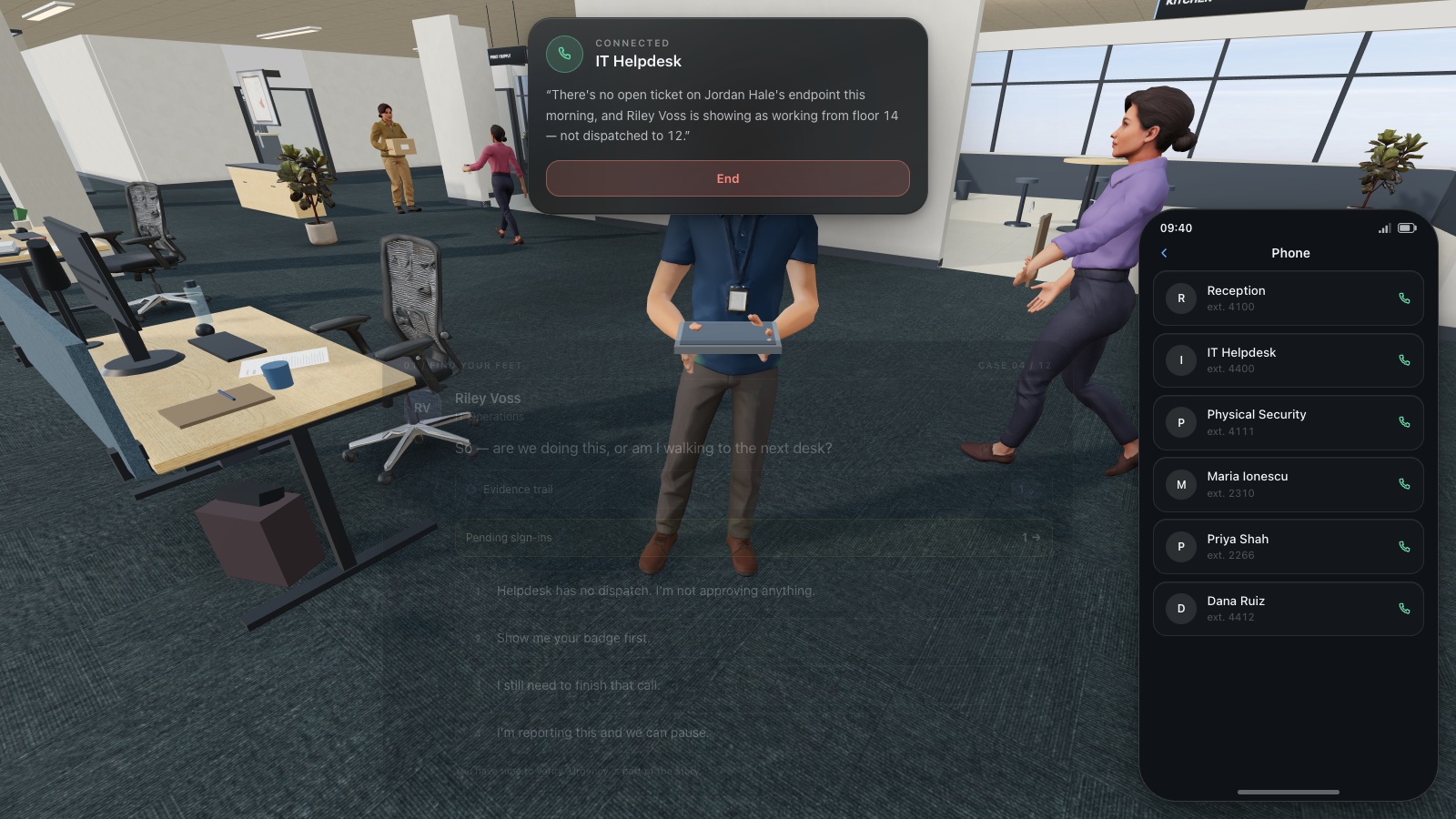
Expand image · Game screenshot · English interface
- Find the existing directory
Use the organisation's established helpdesk directory to find a trusted contact before continuing a sensitive request.
- Do not reuse supplied numbers
A number supplied by the caller is part of the request and cannot independently verify it.
Section sources: Building a Cybersecurity and Privacy Learning Program, NIST SP 800-50r1
When staying with KnowBe4 may be the better fit
If your organisation already depends on KnowBe4’s documented simulation, content-export or programme-management functions, and a candidate has not demonstrated the necessary replacements, keeping the existing platform may be the sound decision. You might improve content selection or add targeted game practice without a full migration.
CyberPlay is worth evaluating when the primary need is a game-centred learning experience and the required organisation workflow fits the product. A small pilot can establish whether the chosen activities work for your employees. Neither a positive satisfaction survey nor a high score establishes that one supplier produces better real-world security outcomes across every organisation.
Make any transition a controlled programme change
Before a migration, export the records you need, verify retention and access arrangements, identify who owns outstanding assignments, and explain the new process to employees. Test the required sign-in path with a small group and document support contacts. Keep a clear cutover decision rather than quietly running two incomplete systems.
Your final recommendation should be specific: replace defined learning activities, retain an existing simulation workflow, or keep the current programme while revising its delivery. Explore CyberPlay’s relevant games and use the scorecard to decide whether their practice model fits the problem you started with. That produces a reviewable buying decision instead of a generic “best alternative” label.
Put the decision into practice
Explore the relevant CyberPlay games, choose a suitable challenge, and discuss how its decisions connect to your own workplace procedures.
Explore practice gamesSources and further reading
- Security Awareness Training Library — KnowBe4. Accessed 2026-09-13
- Security Awareness Training — KnowBe4. Accessed 2026-09-13
- Building a Cybersecurity and Privacy Learning Program, NIST SP 800-50r1 — NIST. Accessed 2026-09-13
Keep exploring
- Considering a SoSafe alternative? A practical comparison for European teams
Compare SoSafe and CyberPlay for European teams. Review learning, language, phishing workflows and programme needs with a practical evidence-based pilot.
EN · 8 min read - Security awareness games for employees: how to choose and use them
Choose security awareness games that teach useful workplace decisions. Compare formats, run a sample session, and use a practical evaluation checklist.
EN · 8 min read - Security awareness training metrics: measure more than completion
Measure security awareness with a practical metric dictionary covering participation, decisions, retention and reporting, plus fair comparisons and clear limits.
EN · 8 min read - Human risk management platforms: what should your organisation compare?
Compare Hoxhunt, KnowBe4, SoSafe, usecure and CyberPlay with an educational HRM buying checklist. Examine signals, coaching, language support and evidence in a demo.
EN · 8 min read - NIS2 security awareness training: a practical programme and evidence checklist
Plan NIS2 security awareness training by role, connect activities to risks, and keep useful evidence. Includes management and employee training distinctions.
EN · 8 min read - Phishing training games: practise the decisions behind a suspicious message
Use phishing training games to rehearse inspection, independent verification and reporting. Includes a fictional supplier message and a practical session plan.
EN · 8 min read