CyberPlay · Published · Updated · 8 min read
Guide and exercises in English
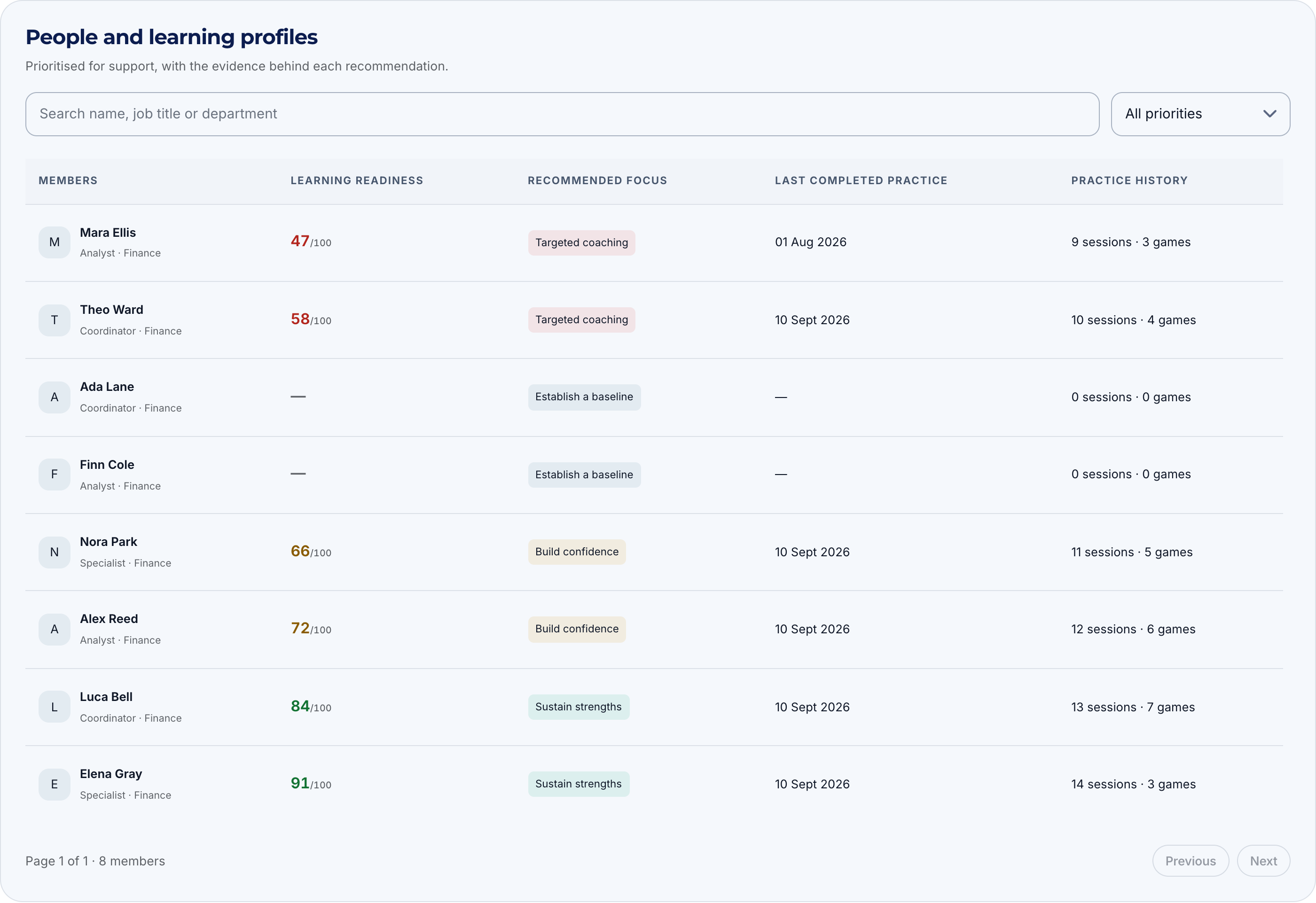
Expand image · Platform screenshot · Example data · English interface
A human risk management platform should help your organisation decide which security behaviour needs attention, what support to provide and how to review the result. Compare the evidence and the working process behind that decision. A long feature list or an attractive risk score cannot establish that a product fits your people, systems and operating capacity.
This guide is published by CyberPlay and includes CyberPlay with CyberSense. It is a documentary comparison of current public vendor materials reviewed on 13 September 2026, not a hands-on benchmark or an independent ranking. Use the same demonstration questions for every supplier. Procurement, privacy and contractual requirements still need your organisation’s review.
What you’ll take away
- Start with one business decision and require evidence that supports it.
- Training results, observed workplace events and technical exposure measure different things.
- Test the learner, manager and administrator experience in each required language.
- Evaluate the work needed to investigate a signal and complete a useful intervention.
1. Define the decision before you shortlist software
Write a concrete problem such as: “Our finance team needs a reliable way to verify requests to change supplier bank details.” Identify the owner, the approved verification route and the information that would show whether staff can use it. This gives a supplier something testable to demonstrate. “Reduce human risk” alone leaves too much room for unrelated dashboards.
Separate capabilities you need now from possible later additions. A team seeking better practice and coaching has a different starting point from one correlating endpoint, identity and email events. Additional integrations may be useful, but they also need owners, permissions and maintenance. Record that operational effort alongside the proposed benefit.
2. Read the vendor comparison as a starting point
The descriptions below summarise selected documented capabilities, not complete packages. The final column is our suggested demonstration question. It does not assert that a supplier supports the requested scenario. Ask which edition, integration and configuration make the answer possible, and distinguish generally available functions from a roadmap.
KnowBe4’s support documentation now calls SecurityCoach “Real-Time Coaching”. Confirm current names in the proposal so that an old comparison does not turn into an incorrect purchasing requirement.
| Product | Selected documented approach | Question to demonstrate |
|---|---|---|
| Hoxhunt HRM | Combines Hoxhunt and third-party events; supports coaching, reminders, training and escalation. | Show one event from its origin to an approved intervention, including an incorrect attribution. |
| KnowBe4 / Real-Time Coaching | Integrated vendor events can trigger SecurityTips and contribute to Risk Score. | Can an administrator explain and stop a coaching action before repeating an inaccurate message? |
| SoSafe HRM Platform | Describes awareness, behaviour and culture signals, HSI scoring and targeted interventions. | Show what changes when one input is unavailable and which features our proposed edition includes. |
| usecure / uHealth | Connects awareness, identity hygiene and access context to prioritise remediation. | For this sample priority, which action belongs to IT and which requires employee learning? |
| CyberPlay / CyberSense | Summarises learning evidence and practice recency to guide organisational coaching. | Show a missing baseline, a practice result and the manager’s next assignment decision. |
Section sources: Human Risk Management · Real-Time Coaching · Real-Time Coaching Overview — updated 10 September 2026 · Human Risk Management Platform · Human Risk Intelligence · CyberPlay for organisations
3. Ask for an evidence trail in the demonstration
Bring a fictional employee and one ordinary workflow. Ask the presenter to show the original observation, its date, the person or group associated with it, the interpretation and the proposed response. Then remove an input or introduce a shared account. A useful demonstration shows uncertainty and correction rather than silently filling the gap.
For a learning platform, inspect the exercise and the choice that generated the result. Ask whether the employee understood the decision or simply repeated a familiar level. For connected workplace telemetry, ask who owns the source event and how duplicate or wrongly attributed events are handled. An alert is a prompt to investigate; its presence alone does not explain intent.
Finish by opening the action itself. A button labelled “coach” may send a message, create a task or merely open another workflow. Record what actually happened and what still needs a person. This evidence trail is more useful in your decision record than a screenshot of an unexplained red score.
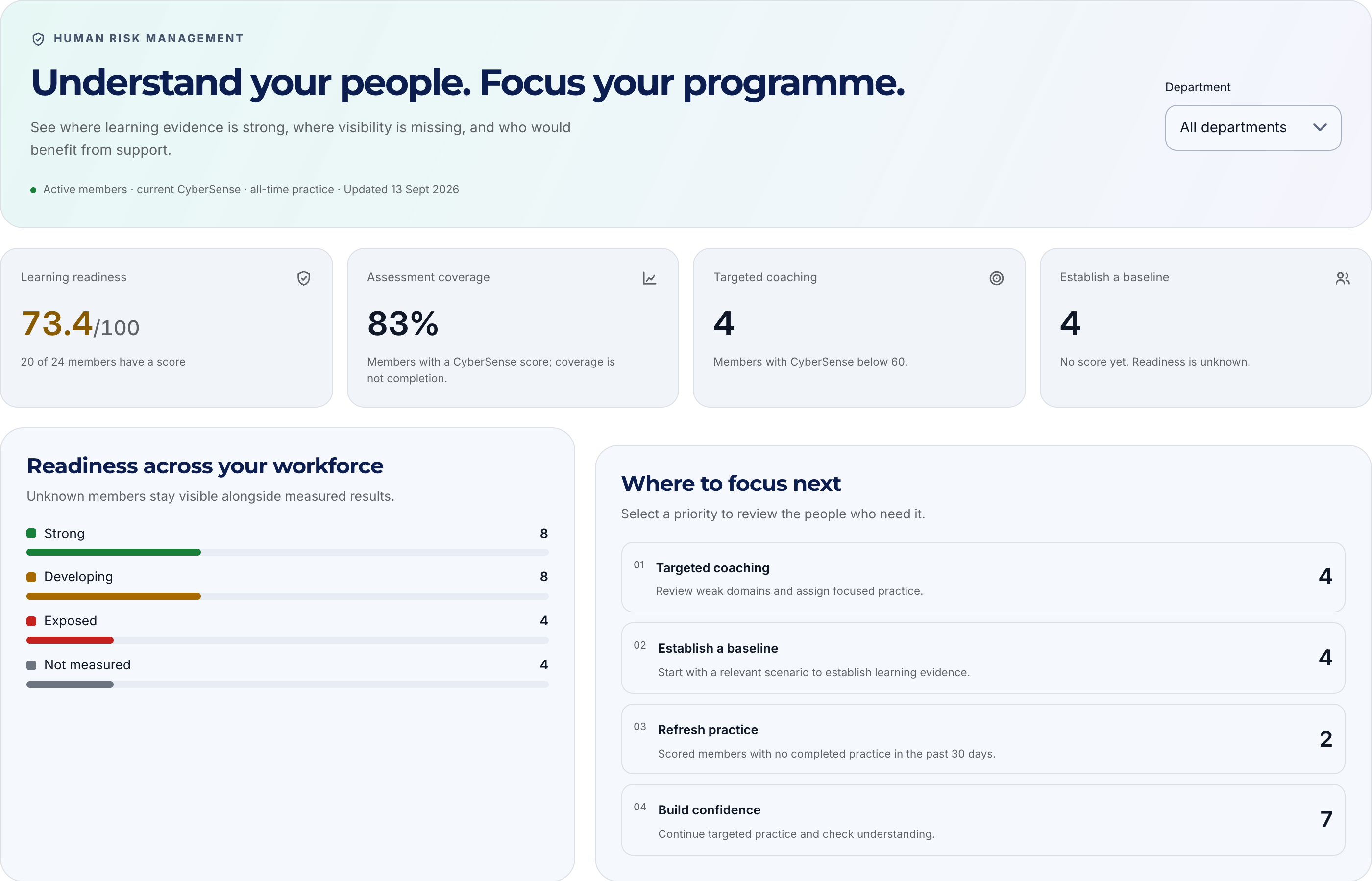
Expand image · Platform screenshot · Example data · English interface
- Mean for measured members
The 73.4 mean describes 20 measured people, not all 24 members. Ask to inspect the included evidence.
- Coverage alongside the score
The displayed 83% is rounded assessment coverage. Four people have no score; do not classify them as safe.
4. Do not compare unlike scores as if they were probabilities
A score of 70 in one product need not mean the same thing as 70 in another. Ask what the scale represents, which direction is favourable, who is included and how missing data is treated. Request an explanation of a score change using a concrete example. Avoid treating an undocumented formula as a probability that a named person will cause an incident.
CyberSense is learning evidence derived from eligible game performance and experience. CyberPlay’s organisational insights use that evidence and practice recency to support coaching. They do not collect identity-security, email or endpoint signals for this view, and they do not estimate incident probability. A current learning snapshot cannot establish a historical trend or prove workplace behaviour changed.
This narrower scope can still be useful when the organisation needs to choose practice and follow-up. If the purchase requires investigation of live identity or email exposure, verify a product that actually supplies those signals. Do not infer feature parity from the shared HRM label.
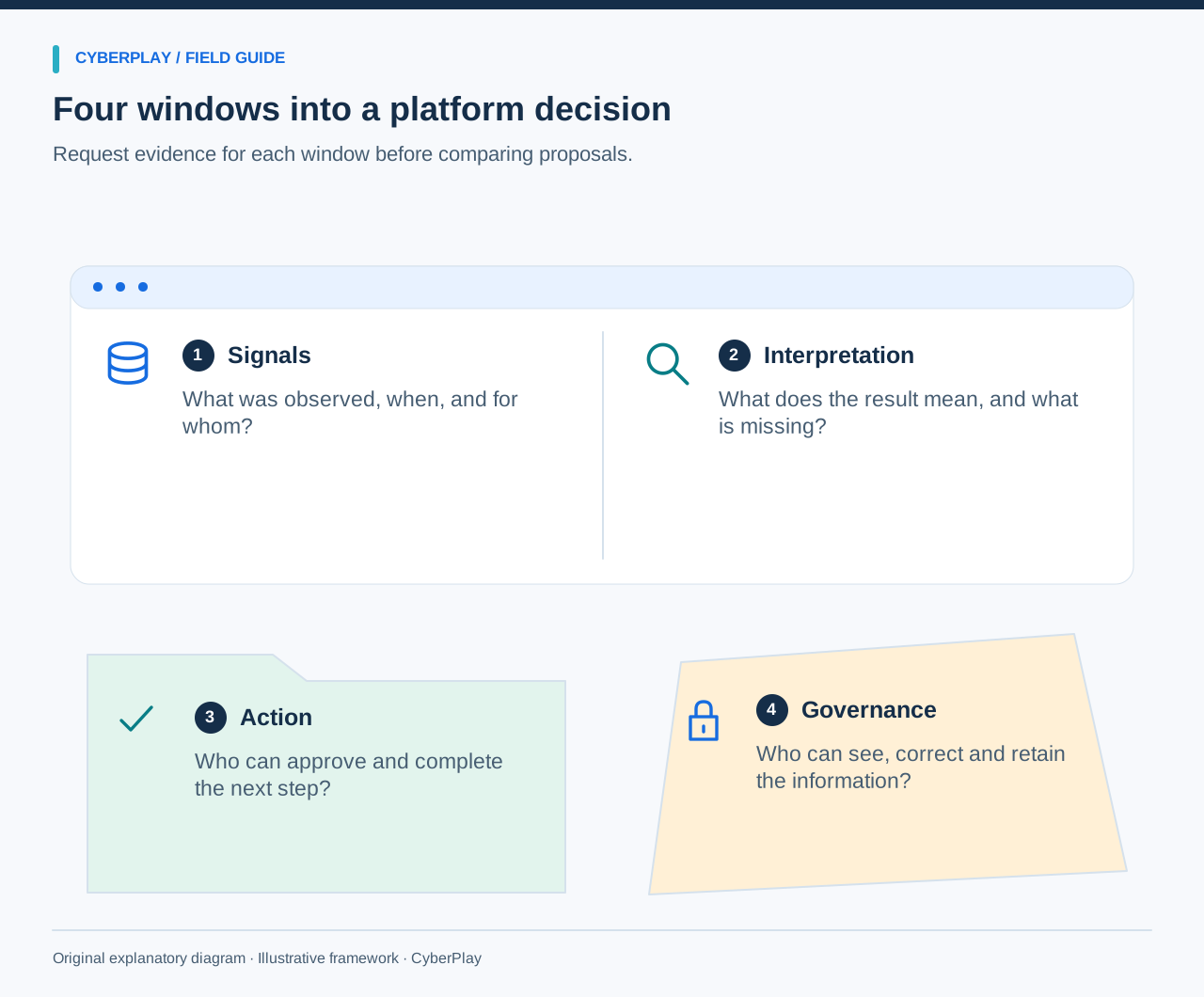
Section sources: CyberPlay for organisations
5. Price the operating work as well as the licence
Ask a future administrator to carry out a small set of tasks during the pilot: add a department, identify people without evidence, investigate a surprising result, choose a suitable learning activity and prepare a manager’s explanation. Count the hand-offs and manual steps. These are likely to matter more to a small team than the number of dashboard panels.
Agree who can see individual results, who may assign work and who handles a correction or employee question. Decide which summaries leadership needs without exposing unnecessary personal detail. Request the applicable retention, access and export arrangements from each supplier. These are procurement questions, not claims that every compared product provides the same controls.
Use the organisational view shown in this article to practise reading a learning population and a coaching priority. The pictured example is a demonstration of CyberPlay’s interface, not comparative proof about another vendor. Check the organisation plan and permissions needed for analytics; free access to a learning activity does not establish free organisational reporting.
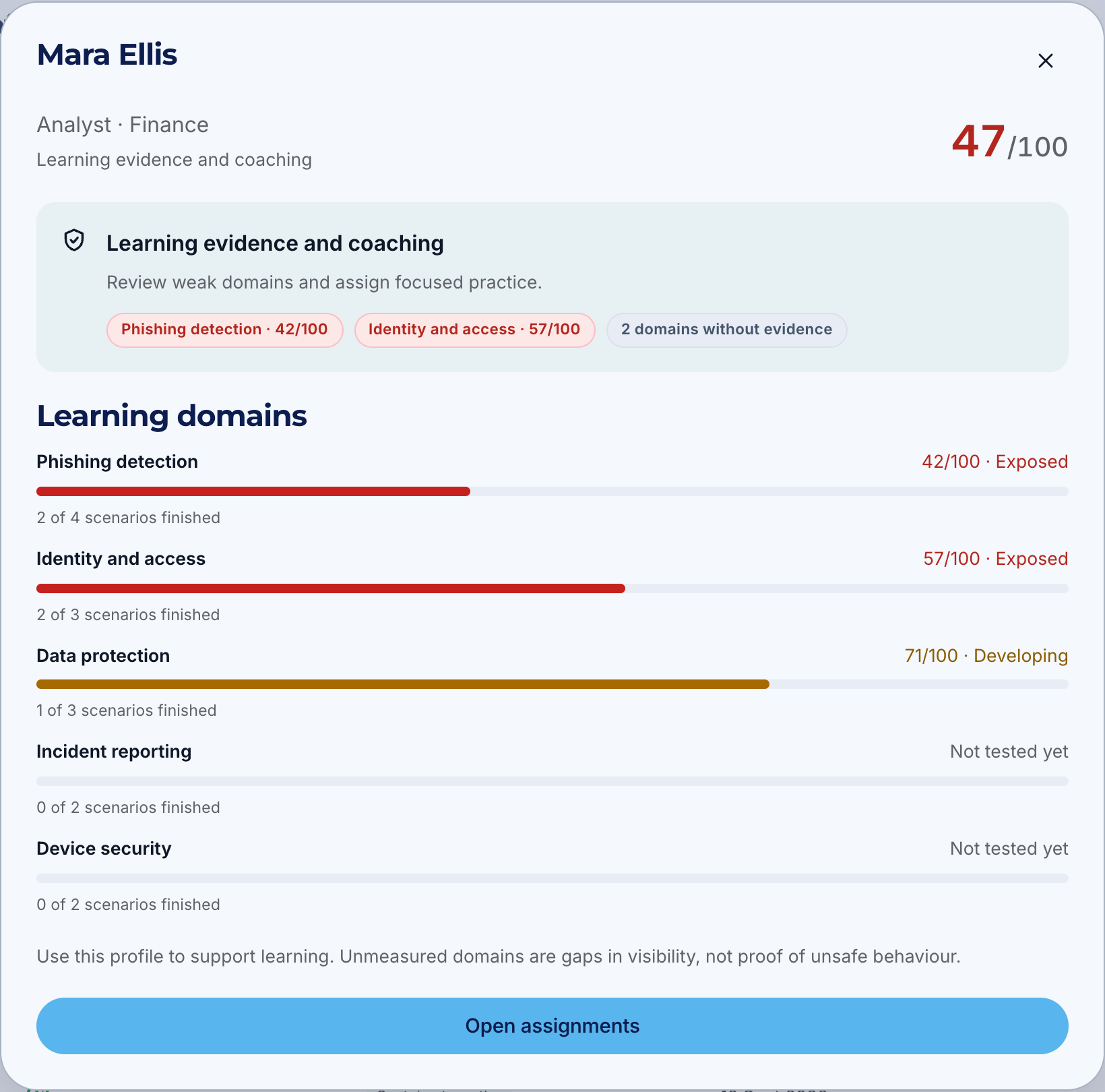
Expand image · Platform screenshot · Example data · English interface
- A focused question
Phishing evidence is 42 here. Discuss the decision and suitable practice, not an assumed incident probability.
- Missing evidence
Incident reporting has no measurement. That is a learning-data gap, not proof of unsafe reporting.
6. Test language and accessibility through the whole journey
An international content library is not enough to establish local usability. Ask an employee to read the invitation, complete the activity, understand feedback and find support in the language they use at work. Ask a manager to interpret the corresponding report. Include keyboard operation, mobile reading and understandable wording in the same check.
This guide and CyberPlay’s platform navigation are available in English. The specific Human risk insights administration labels are currently provided in English and Romanian; the other supported locales fall back to English for these labels. Verify each chosen game separately. Keep familiar terms such as phishing or MFA when they help comprehension, and explain technical labels that change the decision.
7. Rehearse a purchase decision with a fictional pilot
Use a short, controlled pilot with a written success criterion, a named owner and an agreed review date. The following invented numbers test your interpretation of a demonstration. They are not customer results or vendor performance statistics.
8. Leave the demo with a usable decision record
Keep a one-page record for each supplier: the scenario demonstrated, the evidence observed, the unresolved questions, the required package and the person who will run it. Mark a promised future capability as future. If two tools solve different parts of the problem, describe the hand-off and ownership before deciding that you need both.
Choose the platform whose demonstrated process fits your priority and capacity. For CyberPlay, explore organisational learning with CyberSense, targeted practice and manager follow-up. Confirm the actual workflow in a trial or demonstration and evaluate it with the same standards you applied elsewhere. A useful purchase leaves your organisation able to take and review a specific action.
- One priority linked to an ordinary business workflow.
- A traceable observation with scope, date and limitations.
- An understandable response with an accountable owner.
- Language, access and correction checks completed by real users.
- A review date and a result that can be assessed without overclaiming.
Explore organisational learning in English
See how CyberPlay and CyberSense can support practice selection and coaching. Confirm the organisation plan, permissions and language coverage for your team.
Explore CyberPlay for organisationsSources and further reading
- Human Risk Management — Hoxhunt. Accessed 2026-09-13
- Real-Time Coaching — KnowBe4. Accessed 2026-09-13
- Real-Time Coaching Overview — updated 10 September 2026 — KnowBe4 Knowledge Base. Accessed 2026-09-13
- Human Risk Management Platform — SoSafe. Accessed 2026-09-13
- Human Risk Intelligence — usecure. Accessed 2026-09-13
- CyberPlay for organisations — CyberPlay. Accessed 2026-09-13
Keep exploring
- Human risk management: how organisations turn evidence into action
Learn what human risk management means, how it helps organisations and where CyberSense learning insights fit. A practical guide with examples and an exercise.
EN · 7 min read - Human risk management metrics: turn CyberSense into a coaching plan
Read coverage, CyberSense and learning priorities by department. Use a worked example to choose employee coaching, assign practice and review the evidence.
EN · 7 min read - Considering a KnowBe4 alternative? Compare training methods and platform fit
Compare KnowBe4 and CyberPlay by learning experience, simulations, administration and evidence. Use a practical pilot scorecard to decide what fits your team.
EN · 8 min read - Considering a SoSafe alternative? A practical comparison for European teams
Compare SoSafe and CyberPlay for European teams. Review learning, language, phishing workflows and programme needs with a practical evidence-based pilot.
EN · 8 min read - Security awareness games for employees: how to choose and use them
Choose security awareness games that teach useful workplace decisions. Compare formats, run a sample session, and use a practical evaluation checklist.
EN · 8 min read - NIS2 security awareness training: a practical programme and evidence checklist
Plan NIS2 security awareness training by role, connect activities to risks, and keep useful evidence. Includes management and employee training distinctions.
EN · 8 min read